
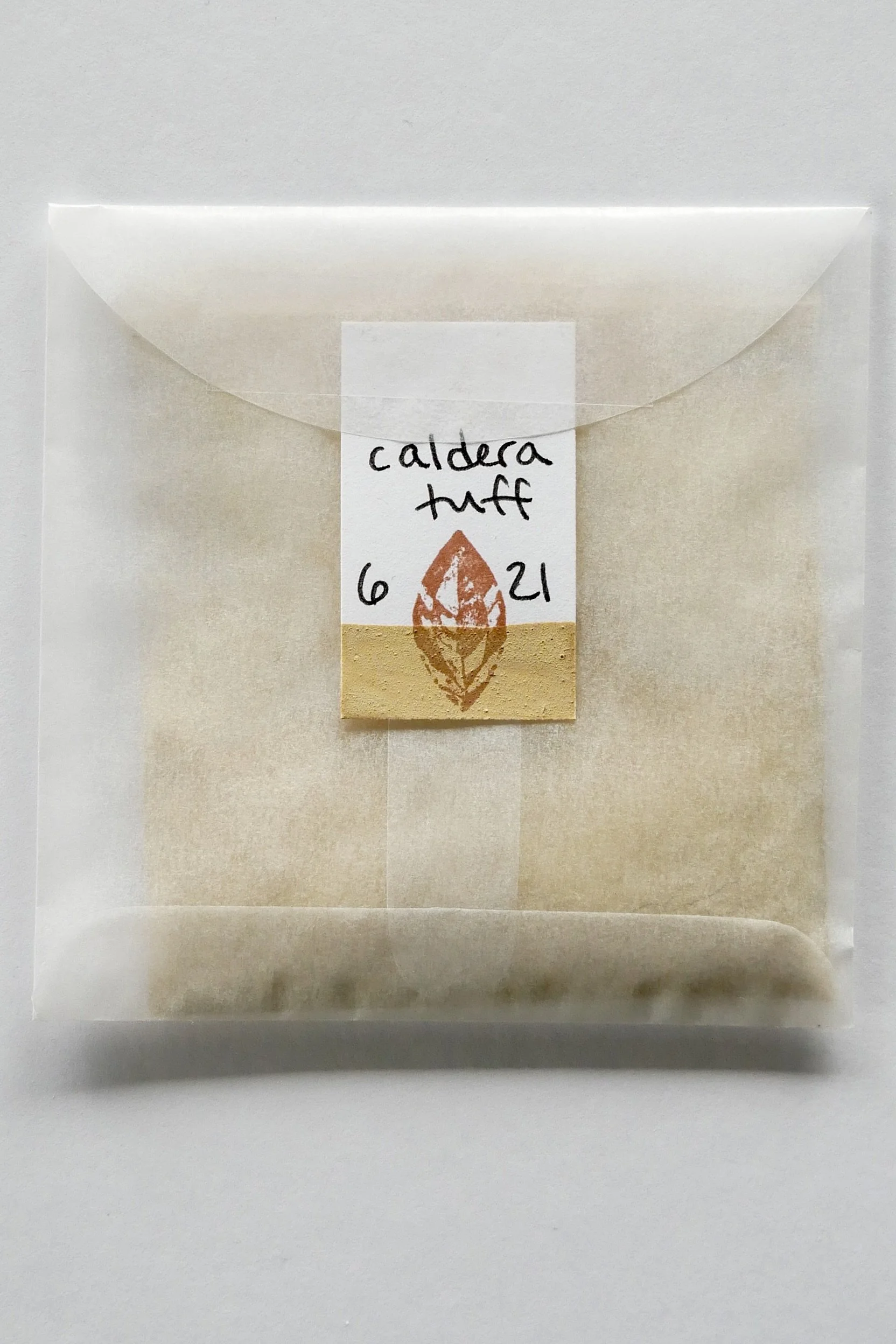

caldera tuff : june ‘21
The yellow ochre for this month’s Ground Bright pigment is composed of Goethite and Jarosite, which erode down as a sediment from the mountain peaks and ridges of exposed geological formations in the Sangre De Christo Mountains of Northern New Mexico known as hydrothermal alteration scars. These scars exist within the steep terrain of a southern facing slope of a 25 million year old volcanic caldera that is over 8 miles in diameter formed by the collapse of a growing batholith. The sediments erode from these scars and settle in the valley bottom next to the river where they are naturally deposited as levigated pigments during summer monsoon rains or spring snow melt. The geological environment from which the sediment forms is a combination of volcanic formations that existed pre and post caldera formation on top of much older basement rock that is 2500 million years old!
contributor : scott sutton
Scott Sutton writes, “My passion for colorful pigments first began while studying for a Bachelor of Fine Art at Oregon State University in 1994 where I learned the art of making paints. The first time pigment hunting opened my eyes to the colors of the Earth was in 2001 when I was living in Taos. It was during this time that I explored the land and collected some beautiful colored clays that I brought home to make into paints. This experience influenced my life by allowing me to better understand the dynamics of geology, topography, hydrology, and ecology that makes each place unique!”

Photo courtesy of Scott Sutton.